


Biotech Scale-Up: Where GMP Reality Hits R&D Assumptions
June 22, 2026
Common Quality Myths That Slow Down Innovative Teams
July 6, 2026Biotech Scale-Up: Where GMP Reality Hits R&D Assumptions
June 22, 2026Common Quality Myths That Slow Down Innovative Teams
July 6, 2026Clinical development strategy is often misunderstood as a scheduling exercise - mapping Phase I, II, and III milestones onto a timeline. In reality, a successful clinical development strategy goes far beyond project planning. It is a comprehensive, evidence-driven framework that determines how a therapy will generate meaningful clinical data, meet regulatory expectations, and ultimately deliver value to patients and healthcare systems.
Across the European Union, where regulatory scrutiny, health technology assessments (HTA), and payer expectations are particularly rigorous; weak clinical strategies frequently derail programs long before they reach regulatory submission. The most common reasons include poorly defined endpoints, lack of regulatory alignment, and unrealistic development assumptions.
Understanding these risks early is critical for biotechnology companies, pharmaceutical sponsors, and clinical research organizations operating in the EU market.
Clinical Development Strategy: More Than Just a Timeline
A clinical development strategy defines the scientific, regulatory, and operational roadmap required to demonstrate a therapy’s safety, efficacy, and value. While timelines are important, they should be the outcome of strategic decisions - not the starting point.
Effective clinical strategies must answer several core questions:
- What clinical outcomes will demonstrate meaningful patient benefits?
- How will regulators evaluate the risk-benefit profile?
- What evidence will payers require for reimbursement?
- How will clinical trials be designed to efficiently generate this evidence?
When companies treat strategy as merely a scheduling exercise, they risk building trials around convenience rather than scientific and regulatory robustness.
Weak Endpoints: A Common Cause of Early Failure
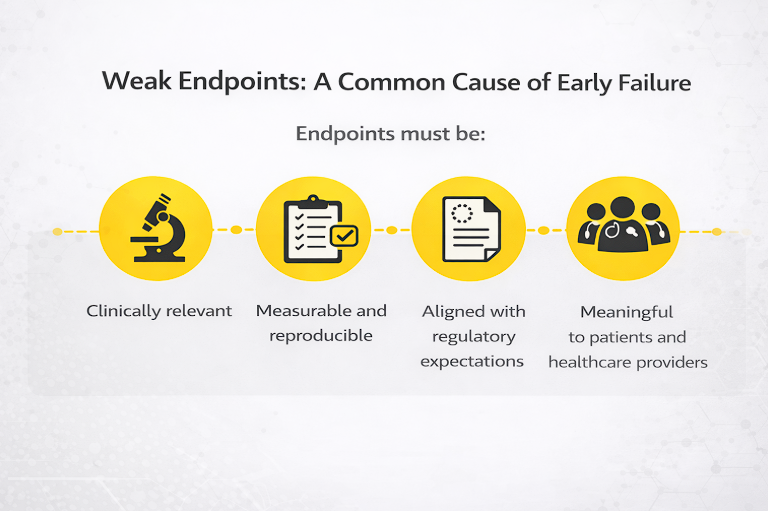
One of the most frequent reasons clinical trials fail is the use of endpoints that do not adequately demonstrate meaningful clinical benefit.
Endpoints must be:
- Clinically relevant
- Measurable and reproducible
- Aligned with regulatory expectations
- Meaningful to patients and healthcare providers
In the EU, regulators and HTA bodies increasingly emphasize patient-relevant outcomes rather than surrogate markers alone. If endpoints fail to capture real therapeutic benefit - such as improvements in survival, disease progression, or quality of life - trial results may not support approval or reimbursement.
For example, therapy might demonstrate statistical improvement in a biomarker but fail to show tangible improvements in patient outcomes. In such cases, regulators may require additional trials, significantly delay development timelines, and increasing costs.
Poor Regulatory Alignment
Another major pitfall in clinical development is insufficient early engagement with regulatory bodies.
The European regulatory landscape involves multiple stakeholders, including:
- European Medicines Agency (EMA)
- National competent authorities
- Health technology assessment bodies
- Payer organizations
Without early regulatory alignment, companies may design trials that fail to meet expectations for approval or reimbursement. Misalignment can lead to:
- Requests for additional studies
- Delays in marketing authorization
- Challenges during HTA evaluations
- Reduced likelihood of reimbursement
Strategic developers therefore prioritize early regulatory consultations and scientific advice procedures to validate their development approach before major investments in large-scale trials.
Unrealistic Assumptions in Trial Design
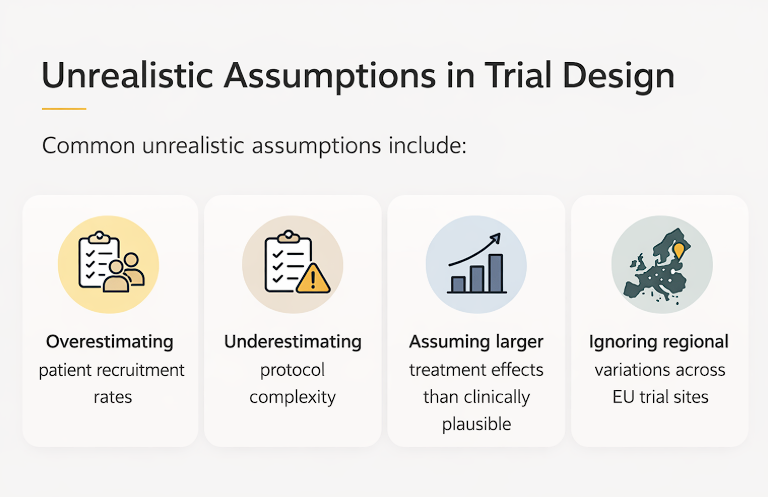
Clinical development strategies sometimes rely on overly optimistic assumptions about recruitment, treatment effects, or operational feasibility.
Common unrealistic assumptions include:
- Overestimating patient recruitment rates
- Underestimating protocol complexity
- Assuming larger treatment effects than clinically plausible
- Ignoring regional variations across EU trial sites
These assumptions can significantly affect trial execution. Slow recruitment, for example, remains one of the leading causes of trial delays in Europe, particularly in rare diseases and specialized therapeutic areas.
Robust feasibility assessments, real-world data analysis, and adaptive trial designs can help mitigate these risks.
Integrating Regulatory, Clinical, and Market Perspectives
Successful clinical development strategies integrate multiple perspectives from the earliest stages of planning:
-
Regulatory Strategy
Ensuring alignment with EMA guidelines and national regulatory requirements.
-
Clinical Science
Selecting endpoints that demonstrate meaningful therapeutic value.
-
Market Access Considerations
Generating evidence that supports reimbursement decisions by EU payers.
-
Operational Feasibility
Designing trials that can realistically recruit patients and generate reliable data.
By aligning these elements early, sponsors can reduce development risk and improve the probability of successful regulatory approval and commercialization.
The Strategic Advantage of Early Planning
In the increasingly complex EU regulatory environment, a well-designed clinical development strategy can mean the difference between success and failure.
Organizations that invest in strategic planning early benefit from:
- More efficient clinical trial designs
- Reduced regulatory uncertainty
- Stronger evidence packages for market access
- Lower overall development risk
Ultimately, clinical development strategy should not begin with a timeline - it should begin with a clear understanding of how a therapy will demonstrate meaningful value for patients, regulators, and healthcare systems.
Conclusion
Clinical trials rarely fail due to scheduling issues alone. They fail when the underlying strategy lacks scientific rigor, regulatory alignment, or operational realism.
For companies pursuing drug development in the European Union, prioritizing endpoint selection, regulatory engagement, and realistic trial assumptions is essential. A strong clinical development strategy ensures that timelines reflect a well-designed path to approval rather than an optimistic guess.
Organizations that recognize this distinction early are far better positioned to navigate the complex path from discovery to successful commercialization.