
Medical devices – how to navigate the role of importer or distributor
February 8, 2026
Biotech Scale-Up: Where GMP Reality Hits R&D Assumptions
June 22, 2026In Medtech, Pharma, and Biotech development, timelines rarely slip because of one big visible failure. Most delays come from smaller, “invisible” issues that don’t show up in the project plan, the Gantt chart, or the weekly status report… until it’s too late.
These pitfalls often look harmless in the early stages: a missing document, a vague requirement, a small design assumption, or a minor gap in testing. But in regulated industries, small gaps compound quickly into rework loops, compliance risks, and months of lost progress.
Below are five hidden development pitfalls that consistently cost teams time, budget, and momentum, and how to identify and avoid them early.
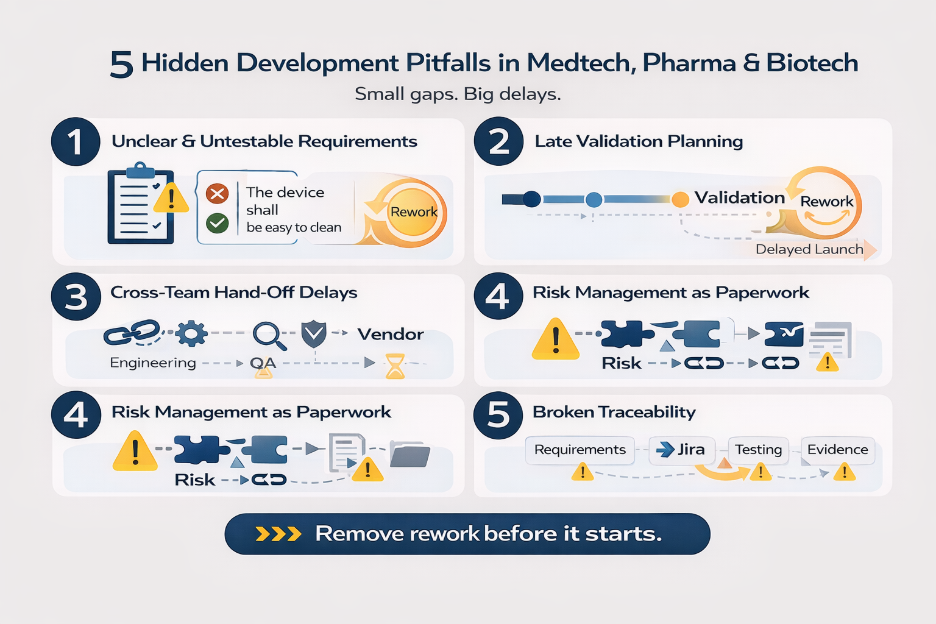
Pitfall #1: Requirements That Sound Clear but Aren’t Testable
Why it happens
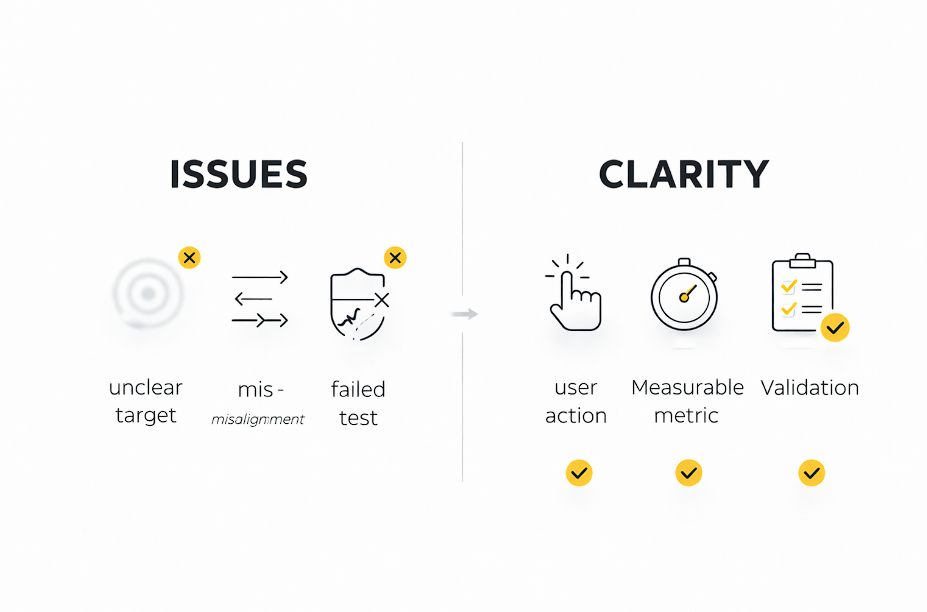
Teams often use requirements that are technically correct but not measurable. For example:
- “The device shall be safe for patient use”
- “The device shall be easy to clean and disinfect”
- “The alarm shall be clearly audible”
These statements feel complete, but they don’t translate into a clear acceptance test. When engineering, QA, and regulatory teams interpret them differently, misalignment begins silently.
Early warning signs
- Frequent clarifications during development
- QA writing test cases late or struggling to define pass/fail
- Multiple stakeholders disagreeing on what “done” means
How to avoid it
Define requirements that are:
- specific
- measurable
- testable
- traceable
In regulated product development, the fastest teams are not the ones who code first. They are the ones who clarify first.
A better definition of the examples above are:
| Bad | Good |
| The device shall be safe for patient use | Patient leakage current shall not exceed 100 µA under normal condition and 500 µA under single fault condition (IEC 60601-1) |
| The device shall be easy to clean and disinfect | The device shall withstand 500 cleaning and disinfection cycles using 70% isopropyl alcohol without degradation of materials or labeling |
| The alarm shall be clearly audible | The alarm shall produce a minimum sound level of 65 dB(A) at 1 meter distance in an ambient noise level of 45 dB(A) |
Pitfall #2: Validation Planning Happens Too Late
Why it happens
Many teams start development assuming validation can be “handled at the end.” But validation in Medtech, Pharma, and Biotech is not just a final checklist, it affects architecture, documentation, traceability, testing strategy, and even vendor selection.
When validation planning is delayed, teams discover late-stage gaps like:
- missing traceability links
- incorrect test coverage
- wrong environment controls
- unapproved tools or workflows
Early warning signs
- “We’ll create the validation plan after MVP”
- No clear test strategy aligned to intended use
- Documentation being treated as a separate phase
How to avoid it
Start validation planning early, even if requirements are still evolving.
A lightweight validation strategy at the beginning can prevent heavy rework at the end.
Pitfall #3: Underestimating Cross-Team Hand-offs (Regulatory, QA, Clinical, Vendors)
Why it happens
In Life Sciences development, engineering is only one part of the timeline. Real delays happen at hand-off points – especially when work moves between:
- product and regulatory
- engineering and QA
- clinical and data teams
- internal teams and external vendors
Each hand-off introduces waiting time, rework, and documentation churn.
Early warning signs
- Stakeholders “reviewing” work without deadlines
- Multiple versions of the same document in circulation
- Delays caused by approvals rather than development
How to avoid it
Define:
- review timelines
- decision owners
- single source of truth
- document versioning rules
A smooth workflow isn’t about moving fast – it’s about reducing friction between teams.
Pitfall #4: Rework Loops Caused by Late Risk Management
Why it happens
Risk management often becomes a compliance activity rather than a development tool. Teams create risk documents because they “have to,” not because they use them to guide design and testing decisions.
When risk analysis is treated as a formality, teams miss critical issues early—then discover them through:
- test failures
- audit findings
- usability feedback
- unexpected edge cases in real-world scenarios
That creates the most expensive type of delay: rework after design is locked.
Early warning signs
- Risk documents updated only before submission
- Risk controls not linked to requirements and tests
- QA and engineering not using risk outputs daily
How to avoid it
Make risk management a living part of development:
- link hazards to design controls
- connect controls to verification tests
- review risks at every major change
When risk is integrated early, it reduces rework instead of creating paperwork.
Pitfall #5: Tooling and Process Gaps That Break Traceability
Why it happens
Many teams build products using a mix of tools that don’t integrate well:
- requirements in documents
- development in Jira
- testing in spreadsheets
- traceability in separate reports
- approvals via email
This works until the project scales, regulations tighten, or a submission deadline approaches. Then traceability becomes a manual effort—often requiring weeks of cleanup.
Early warning signs
- Traceability created manually at the end
- Test evidence stored in scattered locations
- Team members spending time “finding” information
How to avoid it
Build traceability into the workflow:
- use structured requirement IDs
- link stories → tests → evidence
- define templates and approval flows early
- standardize documentation from day one
The best time to fix traceability is before the first sprint begins—not before an audit.
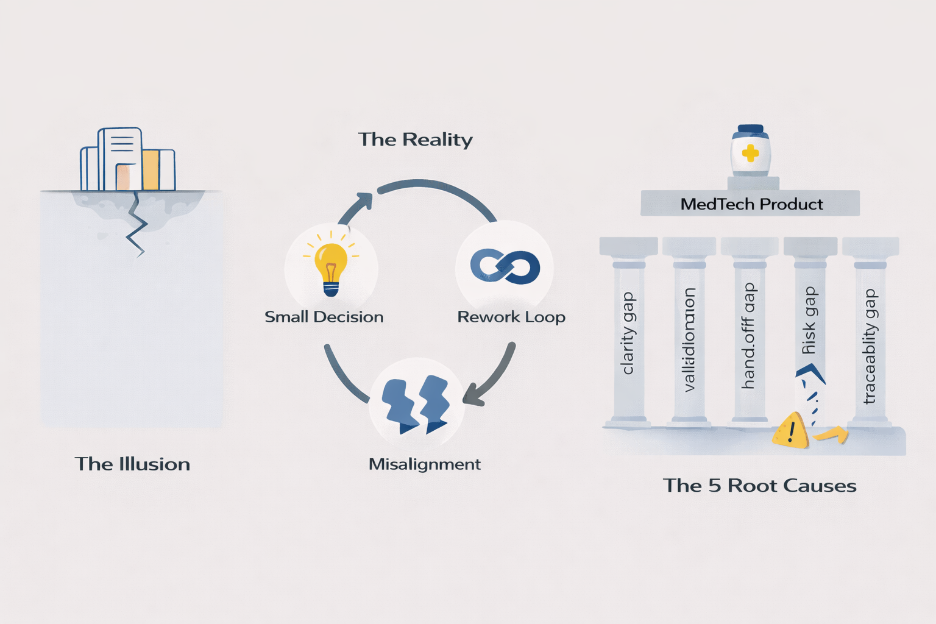
Why These Pitfalls Cost Months (Even When Teams Work Hard)
The most frustrating part is that these delays don’t look like “mistakes” when they begin. They appear as small, reasonable decisions:
- “Let’s keep requirements flexible”
- “We’ll validate later”
- “This is just a small change”
- “We can document it at the end”
But in Medtech, Pharma, and Biotech, development isn’t just building a product – it’s building a product and proving it is safe, compliant, and reliable.
That proof requires structure. Without it, the team ends up running in circles.
How Yallow LifeScience Helps Teams Avoid Hidden Delays
At Yallow LifeScience, we support Medtech, Pharma, and Biotech teams by strengthening the parts of development that often go unseen but drive the timeline:
- clearer requirement definition and traceability setup
- validation-first planning and documentation strategy
- workflow design that reduces cross-team friction
- risk-based development practices
- audit-ready process and tooling alignment
The goal is not to slow teams down with process.
The goal is to prevent the kind of rework that silently steals months.
Conclusion
Hidden delays are rarely caused by lack of effort. They’re caused by gaps in clarity, validation readiness, hand-off workflows, risk integration, and traceability.
If you want to move faster in regulated development, the best strategy is simple:
Remove rework before it starts.