

5 Hidden Development Pitfalls That Cost Medtech, Pharma, and Biotech Teams Months
June 18, 2026
Clinical Development Strategy Is Not a Timeline Exercise
June 22, 20265 Hidden Development Pitfalls That Cost Medtech, Pharma, and Biotech Teams Months
June 18, 2026Clinical Development Strategy Is Not a Timeline Exercise
June 22, 2026Biotechnology innovation often begins in highly controlled research and development (R&D) environments where scientific breakthroughs are validated through small-scale experiments and development batches. However, the journey from a promising laboratory result to commercially manufactured therapy is rarely straightforward.
For biotech companies operating in the European Union, the transition from R&D to large-scale manufacturing introduces a critical shift - from scientific experimentation to strict compliance with Good Manufacturing Practice (GMP) regulations. This stage, commonly referred to as biotech scale-up, is where many early assumptions from development work are tested against the realities of commercial manufacturing.
The hidden gaps between development batches and GMP-compliant production frequently create delays, increase costs, and in some cases force significant redesign of manufacturing processes. Understanding these gaps early is essential for companies aiming to bring innovative biologics, cell therapies, and advanced therapeutics to the EU market.
The Challenge of Moving from Development to Commercial Manufacturing
During the early stages of product development, processes are often optimized for flexibility and speed rather than long-term reproducibility. Development batches are typically produced at a small scale with a focus on proving scientific feasibility.
However, commercial manufacturing requires a very different approach. In the EU regulatory environment, manufacturing processes must demonstrate:
- Consistency across multiple batches
- Robust process control
- Comprehensive documentation
- Full compliance with GMP standards
- Traceability and quality assurance systems
This shift introduces operational and regulatory complexities that many R&D teams underestimate during early development.
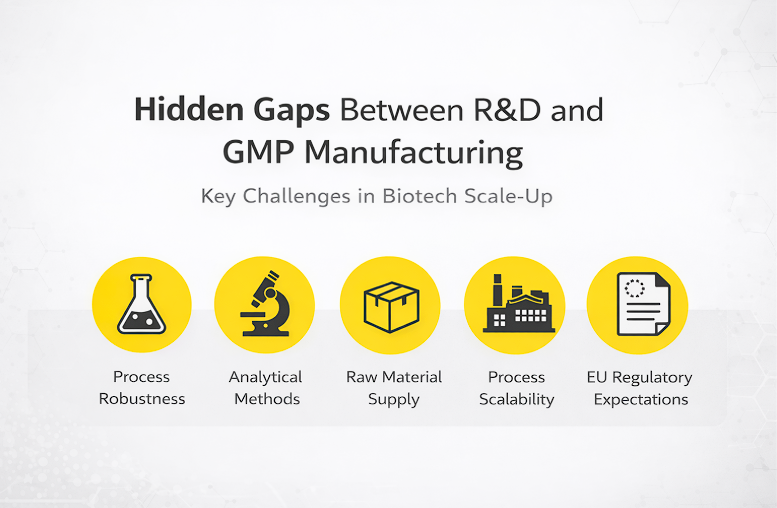
Hidden Gap #1: Process Robustness vs. Experimental Flexibility
R&D laboratories frequently adjust parameters such as temperature, culture conditions, or purification steps during development experiments. These adjustments help optimize yield and product quality but often lack the strict process controls required for commercial manufacturing.
In a GMP environment, manufacturing processes must be fully defined, validated, and reproducible. Even minor variations can lead to batch failures or regulatory concerns.
When development processes are transferred directly to manufacturing without sufficient optimization, companies often discover that procedures that work in small development batches are not robust enough for larger production runs.
Hidden Gap #2: Analytical Methods and Product Characterization
During early development, analytical methods may focus primarily on demonstrating biological activity or confirming basic product identity. However, regulatory expectations in the EU require far more comprehensive characterization.
Commercial manufacturing demands validated analytical methods capable of consistently measuring:
- Product purity
- Potency
- Stability
- Process-related impurities
- Product-related variants
Insufficient analytical readiness can delay technology transfer and create bottlenecks during process validation.
Hidden Gap #3: Raw Material and Supply Chain Complexity
Development teams often rely on research-grade materials that are easy to source and suitable for exploratory work. In contrast, commercial production requires GMP-compliant raw materials, vendor qualification, and supply chain traceability.
Transitioning from research-grade to GMP-grade materials can introduce unexpected variability. Raw material changes may impact yield, product quality, or process performance, requiring additional validation studies.
For biotech companies in the EU, supply chain qualification and regulatory documentation must be addressed early to prevent disruptions during manufacturing scale-up.
Hidden Gap #4: Process Scalability
Processes that perform well in small bioreactors or laboratory systems do not always scale linearly to larger manufacturing equipment.
Common scale-up challenges include:
- Oxygen transfer limitations
- Mixing inefficiencies
- Shear sensitivity of biological materials
- Changes in cell growth behavior
- Downstream purification bottlenecks
Without early scale-up modeling and engineering support, companies may discover these challenges only after investing heavily in manufacturing infrastructure.
Hidden Gap #5: Regulatory Expectations in the EU
European regulators expect strong alignment between development data and commercial manufacturing processes. This means that changes introduced during scale-up must be carefully justified and documented.
Manufacturers must demonstrate:
- Process validation
- Consistency across commercial batches
- Robust quality systems
- Compliance with EU GMP guidelines
If manufacturing processes evolve significantly between clinical and commercial stages, regulators may require additional comparability studies or clinical data.
Bridging the Gap Between R&D and GMP Manufacturing
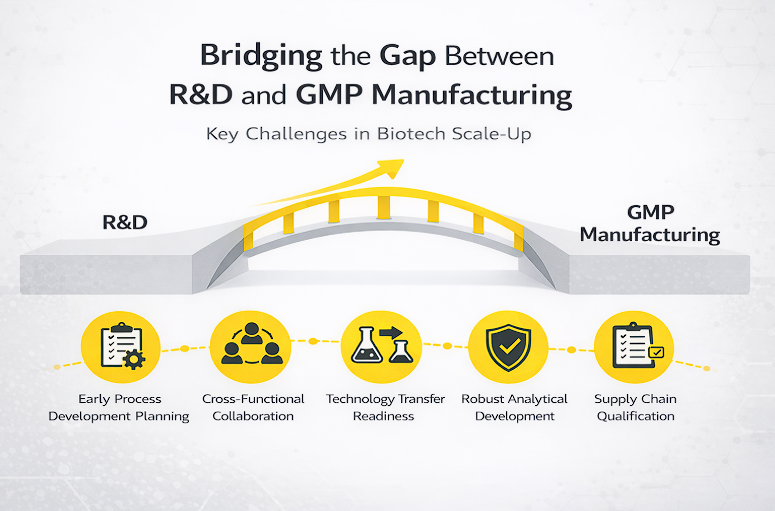
To successfully navigate biotech scale-up in the EU, companies must integrate manufacturing considerations earlier in the development of lifecycle.
Effective strategies include:
- Early Process Development Planning
Designing processes with scalability and reproducibility in mind.
- Cross-Functional Collaboration
Encouraging collaboration between R&D scientists, manufacturing engineers, quality teams, and regulatory experts.
- Technology Transfer Readiness
Developing clear documentation and standardized procedures before moving processes into GMP facilities.
- Robust Analytical Development
Establishing validated analytical methods capable of supporting regulatory submissions and long-term product monitoring.
- Supply Chain Qualification
Identifying GMP-grade suppliers early to minimize disruptions during scale-up.
The Strategic Importance of Manufacturing Readiness
For biotechnology companies aiming to commercialize therapies in the European market, manufacturing readiness is not just an operational milestone - it is a strategic necessity.
Organizations that recognize and address the hidden gaps between development batches and commercial production can significantly reduce risk during late-stage development. Early investment in scalable processes, analytical capabilities, and regulatory alignment helps ensure that promising therapies can move smoothly from the laboratory to patients.
Ultimately, biotech scale-up is the moment when scientific innovation meets industrial reality. Companies that prepare for this transition early are far better positioned to navigate the complex path to successful EU commercialization.